
01
Agro Tourism
Mapro Garden
Famous for strawberry delicacies, freshly baked wood-fired pizzas, and scenic garden landscapes.
Explore Destination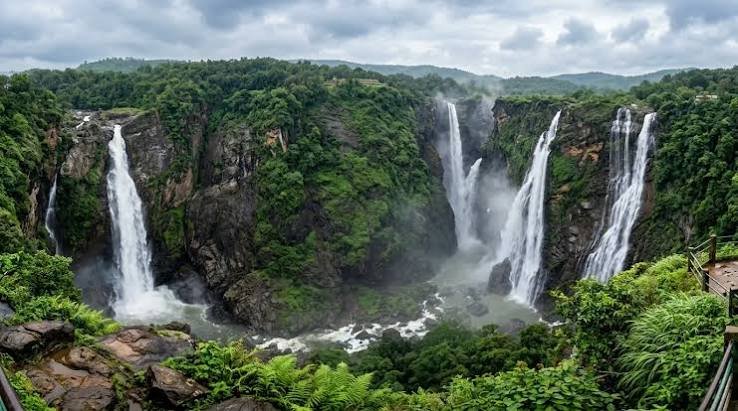
Unlike other waterfalls named after local gods or geographical features, this cascade gets its unique name from the Chinese prisoners who settled the surrounding valley floor and introduced specialized gardening techniques to Mahabaleshwar.
The water does not fall in a single leap. It tumbles over an upper stone shelf, pauses briefly in an intermediate rock hollow, and then drops cleanly down a second vertical cliff wall into the deep gorge.
Because large tour coaches cannot drive up to the edge, the viewpoint remains quiet and natural. The path leading down toward the falls is surrounded by mossy rocks, creeping vines, and dense woodland trees.
| Parameter | Details |
| Distance from Town | ~2.5 km from Mahabaleshwar ST Bus Stand / Main Market |
| Opening Hours | 6:00 AM – 6:00 PM (Daily) |
| Entry Fee | Free (No ticket needed) |
| Vehicle Parking | ₹20 to ₹30 per vehicle (Roadside clearing near the trail head) |
| Time Needed | 1 to 1.5 hours (Including walk, viewing time, and return) |
| Walking Distance | ~400 to 500 meters along a sloping, rustic forest path |
Physical Effort & Trail Conditions:
Cars and cabs park at the edge of the access lane. From there, you follow an earthen and stone path downhill to reach the viewing point.
The downhill walk takes under 10 minutes. The walk back up has a steady incline, but it is manageable for most families with short pauses along the way.
Footwear & Grip:
Wear running shoes or walking shoes with rubber soles. The trail gets dusty in winter and can be muddy or slippery with moss during the rains.
Safety Near the Edges:
Stay on the firm ground of the viewing zone. Do not attempt to walk across wet rock faces or jump over barriers near the drop.
Best Time to Visit:
Monsoon (July to September): The best time to see the waterfall in full flow, surrounded by thick white mist and green slopes.
Post-Monsoon (October to November): The cascade still flows steadily, the jungle remains bright green, and the walking trail is drier and easier to navigate.
Summer (March to May): The waterfall dries up to a trickle or stops entirely, making it primarily a forest walk.
Time of Day: Morning between 8:30 AM and 11:00 AM is best for pleasant walking weather and soft morning sunlight through the tree canopy.
Chinaman’s Falls is located on the southern forest circuit, making it easy to group with nearby viewpoints:
Morning (8:30 AM – 10:00 AM): Head out to Chinaman’s Falls for an easy morning nature walk and waterfall viewing.
Late Morning (10:15 AM – 11:30 AM): Visit nearby Babington Point to look over the wide Koyna valley.
Lunch (12:30 PM – 2:00 PM): Return to the main town market for lunch.
Afternoon (3:00 PM – 4:30 PM): Stop Lodwick point to see the historic stone obelisk.
Evening (5:00 PM – 7:00 PM): Finish your day at Venna Lake for an evening boat ride and hot snacks.
Explore all 35 iconic viewpoints, sacred temples, historic forts, serene lakes, and waterfalls.
Famous for strawberry delicacies, freshly baked wood-fired pizzas, and scenic garden landscapes.
Explore DestinationAsia's second-largest mountain plateau offering horse rides, caves, and sweeping valley vistas.
Explore DestinationSacred temple inside Pratapgad Fort consecrated by Chhatrapati Shivaji Maharaj in 1661.
Explore DestinationA dense UNESCO World Heritage bio-reserve sheltering diverse Sahyadri wildlife and flora.
Explore DestinationMagnificent cascading falls plunging nearly 600 feet into the verdant Venna Valley gorge.
Explore DestinationA peaceful ledge west of Connaught Peak providing wide views over the Koyna river basin.
Explore DestinationNamed after former Governor Lord Northcote, giving expansive angles across deep ravines.
Explore DestinationA sacred basalt temple adjacent to the Mahabaleshwar shrine dedicated to Lord Shiva.
Explore DestinationAncient stone shrine on a cliffside where water flows out of a Gomukh into a natural pond.
Explore DestinationHoly source temple believed to unite five sacred rivers: Krishna, Venna, Koyna, Savitri, and Gayatri.
Explore Destination16th-century Hemadpanti pilgrimage temple preserving a natural rudraksha-shaped swayambhu lingam.
Explore DestinationColonial-era recreation ground offering badminton courts, vintage pavilions, and heritage charm.
Explore DestinationBritish colonial architecture notable for housing Mahatma Gandhi during key negotiations in 1945.
Explore DestinationBuilt in 1829 for Governor Sir John Malcolm, showcasing classical British stone architecture.
Explore DestinationThe spiritual center of the region, housing the historic origins of the town and sacred legends.
Explore DestinationA prime viewpoint offering expansive angles over the lush Koyna river basin and mountain ridges.
Explore DestinationThe vast backwater reservoir of Koyna Dam stretching over 50 km, ideal for speedboating.
Explore DestinationNicknamed 'Mini Kashmir', famous for water sports, lake camping, and strawberry farm agro-tourism.
Explore DestinationA serene waterfall cascading down green valleys, historically cultivated by Chinese gardeners.
Explore DestinationNestled along a secluded forest trail connecting Lodwick point directly to the valley floor.
Explore DestinationCentrally located freshwater lake ideal for row boating, pedal boating, horse rides, and street treats.
Explore DestinationAlso known as Blue Valley, offering sights of quiet hamlets, cascading streams, and green slopes.
Explore DestinationCommands a straight vertical drop down to the canyon floor where the holy Savitri river begins.
Explore DestinationPerched halfway toward Arthur's Seat, looking 500 meters down into Konkan valleys.
Explore DestinationA quiet vantage point surrounded by oak foliage, offering clear views of the Chinaman waterfall.
Explore DestinationFeatures an obelisk monument erected in memory of General Lodwick overlooking deep ravines.
Explore DestinationThe second highest point in the region, formerly known as Mount Olympia with 360-degree vistas.
Explore DestinationA natural rock cliff that resembles an elephant's head and trunk pointing toward the Sahyadris.
Explore DestinationThe historic summer retreat of the Governor of Maharashtra surrounded by heritage forestry.
Explore DestinationLegendary hill citadel that witnessed the historic encounter between Shivaji Maharaj and Afzal Khan.
Explore DestinationDiscovered in 1830, commanding dramatic dual vistas over the Koyna and Savitri river valleys.
Explore DestinationOne of the earliest explored vantage spots, widely famous for its evening sunset horizon.
Explore DestinationThe highest altitude plateau in Mahabaleshwar featuring three observation towers to view dawn.
Explore DestinationOffers sweeping panoramas of Dhom Dam, Kamalgad, and the deep blue waters of the Krishna basin.
Explore DestinationMahabaleshwar's most iconic cliff overlooking the deep abyss between Konkan and the Deccan.
Explore Destination



Mahabaleshwar Tour Packages is a specialized division of Pravas Sukhacha Network & Ecosystem.
Pravas Sukhacha Office 201, 2nd Floor, Raigad Complex, Salatwada Main Road, Vadodara – 390001, Gujarat
Business Hours:
Monday to Saturday: 10:00 AM – 7:00 PM
Sunday: Closed
Copyright © 2026 All Right Reserved Mahabaleshwar Tour Packages